
In the high-stakes aerospace hangars of 2026, the traditional boundary between "designing" an engine and "building" it has officially dissolved. As top-tier jet engine manufacturers face mounting pressure to deliver next-generation fuel efficiency and record-breaking Time on Wing (TOW), a new strategic mandate has emerged: the assembly line is no longer the end of the process—it is the beginning.
Industry data from early 2026 suggests that aerospace manufacturers engaging in precision assembly early engagement are seeing up to a 30% reduction in program rework and a significantly faster path to FAA certification. At the center of this shift is ABTech, an aerospace manufacturing partner that helps manufacturers optimize turbine engine assembly design for sub-micron precision environments.
The End of the "Reactive" Assembly Era
For decades, the standard operating procedure was linear: design the engine, freeze the specifications, and then find a system to assemble it.
However, as the industry moves toward ultra-high-bypass engines and hydrogen-ready cores, tolerances have tightened to the sub-micron level. The traditional approach is no longer just inefficient. It introduces risk.
When a jet engine manufacturer engages a partner like ABTech during the initial turbine engine assembly design phase, they are essentially "pre-solving" the friction points of production. By the time a design reaches a "freeze," the tolerance stacks, bearing strategies, and interface constraints are already optimized for repeatability.
"Waiting until the prototype phase to think about assembly is like trying to change the foundation of a house after the roof is on"
Engineering Outcomes Over Parts
The shift toward early engagement is about moving from a "catalog" mindset to a "system" mindset. When an aerospace manufacturing partner participates during the CAD and design phase, manufacturers see measurable benefits across several areas.
- Tolerance Integration and Allocation Micron-level alignment in high-pressure turbine (HPT) shafts cannot be corrected later in the process. Early collaboration allows engineering teams to model tolerance stacks before production begins. This ensures that the assembly architecture supports the design intent, rather than attempting to compensate for misalignment later.
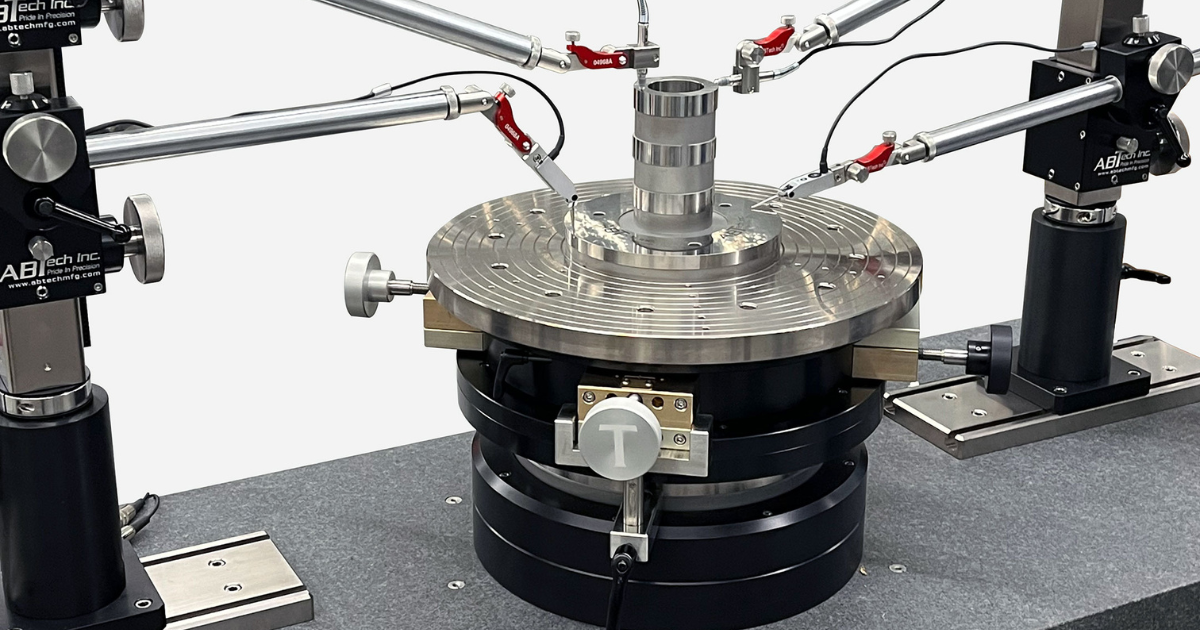
- The Architecture of Stability A common oversight in turbine assembly design is assuming that the factory environment is perfectly stable. In reality, vibration, temperature variation, and floor dynamics affect precision assembly. By collaborating early, aerospace manufacturers can design assembly cells around Natural Granite Bases, which provide the thermal stability and vibration damping required for precision turbine assembly. These structures enable runout measurement accuracy within five millionths of an inch, creating the stable environment necessary for advanced aerospace manufacturing.
- Setup Topology and the Labor Factor In modern aerospace programs, engineering hours translate directly to cost and schedule risk. Selecting a Spherical Seat Tilt-and-Center design during tooling specification allows massive turbine modules to self-align quickly. This approach eliminates time-consuming measurement cycles and allows assemblies to locate their true center in minutes rather than hours, improving efficiency across the program lifecycle.
The Data Birth Certificate: Connecting Hardware to the Digital Twin
As a licensed supplier of GE Aerospace Genspect systems, ABTech bridges the gap between physical hardware and digital threads during the early engineering phase. This symbiosis ensures that every HPT and HPCR stack is balanced with mathematical certainty before it ever encounters the stress of a test cell. This "Data Birth Certificate" is the ultimate insurance policy for long-term engine durability and Time on Wing (TOW).
Ready to architect your precision moat?
Contact an ABTech Systems Specialist to schedule a design-phase consultation or request a technical deep-dive on our EAS Series turbine engine assembly systems.
Can’t Find What You’re Looking For?
Our experts can help you design a fully custom solution.
Quick links to our linear stages: