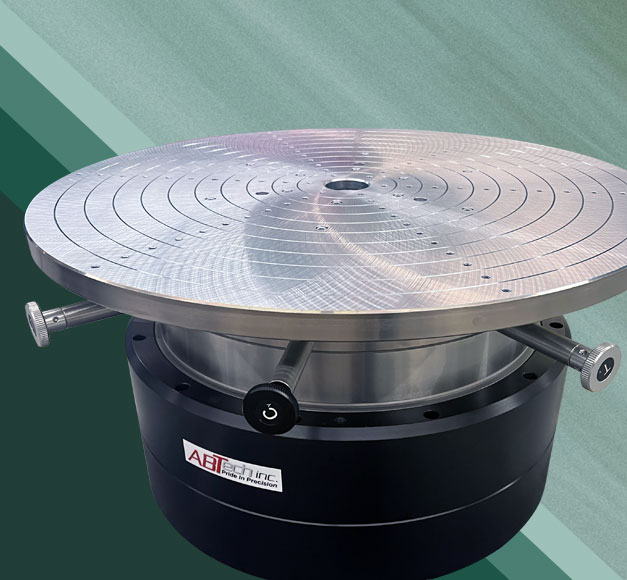
Precision manufacturing requires consistency, reliability, and the right motion solution tailored to your specific application. Rotary tables play a critical role in achieving all three. But with multiple technologies available, how do you choose the right one?
Let’s break down the three most common types of high-precision rotary tables and where each one performs best.
What is a High-Precision Rotary Table?
A rotary table is a positioning device that holds and rotates a part with exceptional accuracy. These systems are essential in applications where repeatability and precision directly impact performance, helping manufacturers improve throughput while maintaining tight tolerances.
Air Bearing Rotary Tables: Maximum Accuracy, Zero Wear
Air-bearing rotary tables use a thin film of pressurized air to support the load, eliminating mechanical contact entirely.
Why it matters:
- No friction or wear
- Long-term accuracy and repeatability
- Minimal maintenance over decades of use
These systems are ideal for metrology, optics, precision assembly, and light machining, as well as any application where ultra-smooth motion and sustained accuracy are critical.
Oil Hydrostatic Rotary Tables: High Load, High Stability
Oil hydrostatic tables operate similarly, but use a fluid film of oil instead of air. This allows them to support significantly higher loads while maintaining smooth motion.
Best suited for:
- Grinding and heavy machining
- Applications requiring high stiffness
- Environments where load capacity is a priority
Mechanical Bearing Rotary Tables: Versatile and Proven
Mechanical-bearing rotary tables utilize traditional contact bearings, offering a flexible and widely applicable solution.
What to expect:
- Strong performance across radial, axial, and angular motion
- Broad application compatibility
- Shorter lifespan compared to non-contact systems
While they may introduce wear over time, they remain a dependable option for many manufacturing environments.
Which Rotary Table Is Right for You?
There’s no universal answer. Only the right fit for your application.
- For ultimate accuracy and longevity: Air-bearing
- For high load capacity and stiffness: Oil hydrostatic
- For versatility and proven performance: Mechanical-bearing
The key is aligning the technology with your process requirements.
Proven Process, Backed by Our Engineering Team
“Understanding your application’s needs makes it easy for our Sales & Engineering Team to find the right product to enhance your process, leveraging a vast design library of precision rotary tables. Whether using air, oil, hydrostatic, or mechanical-contact bearings, we help design simplicity, robustness, and value into your program, starting with a thorough understanding of your needs. Our goal is to turn these initial conversations into long-term relationships and collaboration.”
— Joe Kelly, ABTech Engineering Manager
A Better Approach: Application-Specific Engineering
Selecting the right rotary table isn’t just about specs; it’s about understanding the full system and how it performs in your environment.
That’s where ABTech comes in.
We take a solutions-engineering approach, designing application-specific systems that integrate the right motion technology for your process. Whether you’re refining an existing setup or building something entirely new, our team works with you to ensure the best possible outcome.
Let’s start the conversation.
Can’t Find What You’re Looking For?
Our experts can help you design a fully custom solution.
Quick links to our linear stages: