In the high-stakes world of aerospace manufacturing procurement, the most seductive trap is the catalog solution. On paper, an off-the-shelf motion stage appears to solve immediate budget concerns. It offers lower upfront capital costs, immediate availability, and a recognizable model number.
However, as modern engine programs advance in 2026, top-tier jet engine manufacturers are discovering that standard components often carry a hidden long-term cost in productivity, integration complexity, and system performance.
For aerospace manufacturers, the choice between application specific turbine assembly systems and modular components is not simply about hardware. It is a decision between managing multiple vendors or investing in a complete manufacturing outcome.
The Integration Tax: The Hidden Cost of Off-the-Shelf
Off-the-shelf (OTS) systems are typically designed for a broad range of industries, from semiconductor labs to general metrology environments. They prioritize versatility rather than the specific dynamic conditions found on a turbine assembly floor.
When a jet engine manufacturer selects modular catalog components, internal teams often assume the responsibility of system integration. This includes designing gage towers, specifying granite bases, integrating software interfaces such as GE Aerospace Genspect, and connecting multiple motion components into a unified assembly system.
In many cases, this internal engineering effort exceeds the original hardware savings.
By 2026, the hidden integration tax often appears in several forms:
- Extended Ramp-up Times: Months spent debugging "standard" software to fit specific turbine protocols.
- Error Propagation: Modular parts from different vendors often lack the unified thermal stability required for sub-micron repeatability.
- Maintenance Complexity: A "Frankenstein" system requires multiple service contracts and a deeper internal knowledge base to keep the line running.
The Lifecycle Advantage: Why Custom is a Strategic Asset
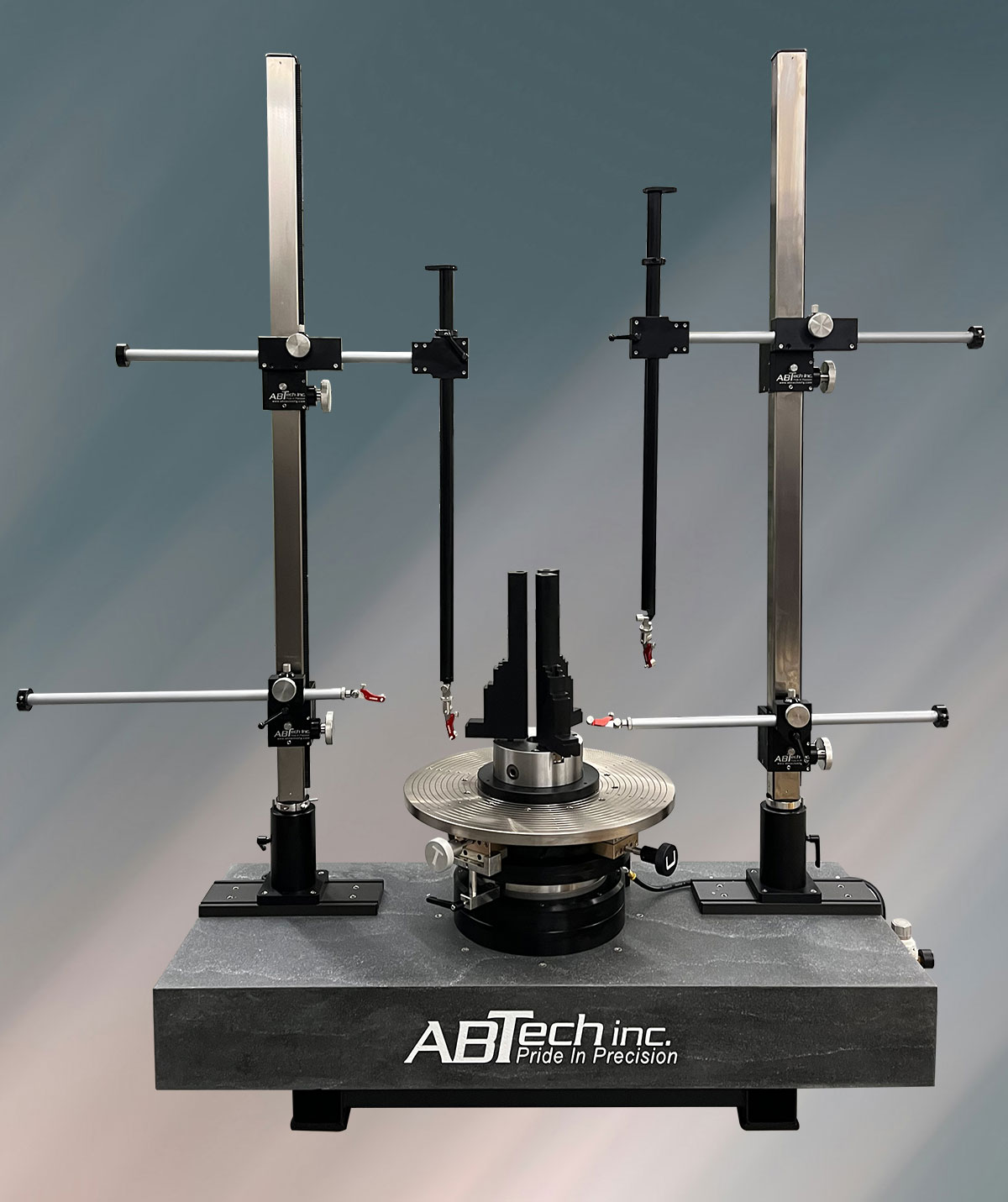
A custom turbine assembly system, such as the ABTech EAS Series, is architected for a single, uncompromising goal: the perfect engine stack. When aerospace manufacturers invest in custom systems, they are effectively eliminating variables that can affect long-term production performance.
The lifecycle return on investment for a custom platform is built on several key advantages that standard catalog components cannot replicate.
- Reduced Setup Latency: Standard rotary tables often require time-consuming leveling adjustments. A custom ABTech system uses Spherical Seat topology, allowing technicians to tilt and center large turbine modules while maintaining the center point. For jet engine manufacturers operating high-volume production programs, reducing setup time by even 90 minutes per module can translate into significant reclaimed production capacity over the life of a program.
- Native Digital Thread Integration: Off-the-shelf motion stages typically provide basic position data. Custom systems provide deeper system intelligence. By integrating GE Aerospace Genspect stack-prediction software directly into the controller architecture, ABTech ensures that as-built assembly data connects seamlessly to the engine’s digital twin as soon as assembly is completed.
- "Shop Floor" Resilience: Catalog parts are often designed for cleanroom environments. Custom systems are built for the actual shop floor. By specifying high-mass Natural Granite Bases and passive vibration isolation, custom systems maintain sub-micron accuracy even in the presence of nearby robotics and heavy logistics.
Procurement Reality Check: The Cost-Benefit Matrix
|
Feature |
Off-the-Shelf (Modular) |
Custom (ABTech EAS) |
|
Upfront CapEx |
Lower |
Higher |
|
Time to Production |
6–12 months (Integration) |
Turnkey (Immediate) |
|
Labor Requirement |
High (Internal Engineering) |
Low (System Partner) |
|
Durability / TOW |
Variable |
Maximum (Designed-in) |
|
Service Model |
Multi-vendor |
Single-Point Accountability |
The Verdict: Investing in the Outcome
In modern aerospace manufacturing, the assembly line is no longer just a production step. It is an extension of the engine’s performance architecture.
Choosing a custom turbine assembly system represents a strategic investment in reliability, repeatability, and long-term program success. It ensures that precision is built into the assembly process rather than corrected later.
For jet engine manufacturers scaling next-generation propulsion programs, the real question is no longer whether a custom system costs more upfront.
The real question is whether manufacturers can afford the hidden operational costs of relying on standard modular systems.
Can’t Find What You’re Looking For?
Our experts can help you design a fully custom solution.
Quick links to our linear stages: